


Pope Pius XI once called the Capuchins “the Marines of the Church” because they go where others hesitate to go to do God’s work. The Capuchins go, knowing they have God and their brothers with them.
This joyful can-do spirit is alive and well in the Lower East Side of New York City. When the Archdiocese of New York asked Fr. Thomas McNamara, pastor of Our Lady of Sorrows Parish, to be the administrator of another neighborhood parish, St. Mary, he said yes.
Our Lady of Sorrows, located at 213 Stanton St., and the Church of St. Mary, mere blocks away at 440 Grand St., are among the oldest churches in Manhattan. Both enjoy a rich and diverse history. The Archdiocese of New York established Saint Mary in 1826, the first church in New York City dedicated to Mary. It came to serve a growing Irish immigrant population. Our Capuchin forebears established Our Lady of Sorrows in 1867. German immigrants filled the pews in the first generation, and they were followed by Italian immigrants after the turn of the century
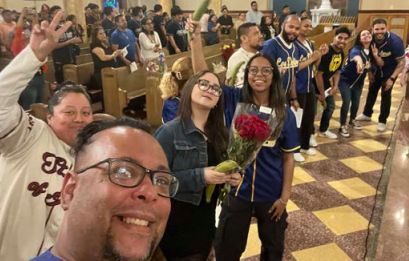
Today, the parishes serve an estimated 500 families each, largely of Hispanic heritage. “They bring warmth, liveliness, great food, dancing, color, and a wonderful faith and devotion that inspires me,” said Father Tom. “We try to do things bilingually, and I definitely get the most enthusiastic response when I speak in Spanish.”
A Providential Calling
One could say Father Tom was destined to minister to a Spanish-speaking immigrant community. His grandparents were Italian immigrants, and his grandfather married an immigrant from Guadalajara, Mexico, after the death of his first wife. “This may have influenced my mom to become a Spanish teacher, who further influenced me to learn basic Spanish in high school,” Father Tom said. His interest in agriculture afforded him further exposure to his Spanish-speaking neighbors. “After earning my degree in agriculture from Cornell, I went on to work in landscape construction. Many of my co-workers were Mexican immigrants, from places like Jalisco, Durango, and Zacatecas.”
He went on to follow in his mother’s footsteps, teaching agriculture in high school in the Southern Tier of New York State. However, as he says, “the Lord wanted my all,” so he left education to work at Unity Acres, a Catholic Worker farm in Oswego County. There, he met someone who introduced him to the Capuchins and his eventual vocation as a religious. “I tried the diocesan route first, but I found the Capuchin charism to be more my style.”
Father Tom’s ministry with immigrants evolved during his first assignment after ordination, St. Joseph the Worker Parish in East Patchogue, N.Y. He worked in a drop-in center in Freeport, where he would serve among many of the area’s day laborers. After this, he served as the parochial vicar at Our Lady of Sorrows from 2009 to 2013. After two years of mission in Nuevo Ocotepeque, Honduras, and two years at Capuchin Youth & Family Ministries, he returned to Sorrows in 2017 as pastor.
Last November, he was installed as the pastor of St. Mary. “Our charism is to be brother to people, to accompany them,” said Father Tom. “We always assist the Church.” Priests everywhere are being asked to assume pastoral care of multiple churches. As a religious order, the Capuchins need not have accepted the archdiocese’s request to take charge of St. Mary. But the friars agreed, said Father Tom, quite simply, “to do the work that must be done.”
Up until now, St. Mary was led by diocesan clergy. There are differences in the ways diocesan clergy and religious clergy like the Capuchins handle the administration of parishes. One of Father Tom’s challenges has been introducing the Capuchin charisms into a parish accustomed to diocesan management. “As Capuchins, our life is centered around brotherhood,” said Father Tom.
“One of St. Francis’ innovations was democracy, and we carry that charism into parish life.” In one of his first acts as pastor, he reinstituted the parish council and various committees, including a liturgy committee and an activities committee. The activities committee is comprised of representatives from all the parish groups, ministries, and societies. These representatives collaborate to ensure there is a proving ground for all parish activities. “For democracy to function, you have to have a platform for dialogue,” Father Tom said. “Capuchins are always seeking consensus.”
He believes that this collaboration, although unsought, will increase faith among parishioners. “If people see their part, they will more joyfully pull the load,” he said. “We need to work with each other. This is not my parish. It belongs to [the parishioners] and the Lord.”
“Some people see no difference between a Capuchin parish and a diocesan parish. But I think perhaps there is a broader range of leaders and guides available among the friars,” said Br. James Donegan, guardian of the fraternity of Our Lady of Sorrows. “Because of our sense of fraternity, people may be exposed to our sharing of duties. It shows them what it means to be part of the body of Christ.”
Limited resources require difficult decisions around longcherished customs. For instance, Father Tom had to change the Mass schedules to work around the availability of a limited pool of priests. “This is a model that is becoming more common,” he said.
Facilities management is a large part of Father Tom’s responsibilities. His predecessor at St. Mary had the building landmarked and the rectory refurbished. Now, Father Tom focus is going to refurbish the church and sanctuary. “The building is very beautiful but old and needs work,” he said. “We’ve already hired some people to start the renovations. But the job is quite complex. In New York City, there are so many laws and regulations to consider.
Supporting the Lower East Side
Parish life at both Our Lady of Sorrows and St. Mary is deeply integrated with the concerns of the Lower East Side community. Both parishes are members of Manhattan Together, an interfaith organization that works for effective social change by improving the quality of life in the community. Member meetings take place at the parishes and are led by a staff organizer. At these meetings, members find consensus around what issues to address and what solutions are available. The organization takes credit for winning a $13 billion settlement with New York City for mold remediation and for getting the New York City Housing Authority to establish an ombudsman’s office to address grievances raised by tenants in public housing.
Manhattan Together helps the friars help their neighbors in need. One woman recently approached Father Tom for help when the housing authority removed a cabinet to replace a faucet but never returned to fix the hole they left behind in the wall. “They told her it couldn’t get done till 2025,” he said. “We sent a rep from Manhattan Together, and it was done within a day.”
Another faith-based group that Father Tom works with is Catholic Homes. This organization works in collaboration with Catholic Charities of New York to develop safe and affordable housing for families and seniors. Father Tom is a member of the Catholic Homes board.
Strength in Brotherhood
Like many friars, Father Tom balances multiple ministry commitments. He is the pastor of two churches. He collaborates with church and community organizations on works of mercy and justice. He also serves on the friars’ provincial council, which meets two days a month For the last four months of 2023, he had no parochial vicar to assist him at Our Lady of Sorrows and St. Mary. “It was way beyond my ability to micromanage,” he said.
Fortunately, he could rely on his brother friars to help him bear his burden. During the interim without a vicar, two of our Spanishspeaking friars in Brooklyn, Fr. Arlen Harris and Fr. Richard Mattox, stepped up to assist with liturgies and sacraments. In January, Fr. Divya Karunesh arrived from Holy Trinity Province, Karnataka, to be parochial vicar. And Fr. Benedict Ayodi, one of the friars in residence at Our Lady of Sorrows, was enlisted to help with English Masses.
Although he is not a member of the parochial staff, Brother Jim also animates parish activities. During Lent, he led a parish mission at Sorrows on St. Francis of Assisi, penance, and reconciliation. He said it drew a great number of parishioners from St. Mary as well. Recently, he shared his vocation story with the Our Lady of Sorrows youth ministry at a gathering held in the parish community garden. Brother Jim also participates in the parish’s weekday Masses on Tuesdays and Thursdays. “On Sunday, I even find time to sing with the choir,” he said.
Our Lady of Sorrows is both a parish and a friary. As guardian of the fraternity at Sorrows, Brother Jim is responsible for the spiritual and material welfare of the six brothers in residence. This includes, among other things, regulating the schedule of prayers and meals, paying the bills, and coordinating house meetings, called chapters. Like Father Tom, he serves on the provincial council and juggles multiple jobs (see Page 8). Through all the friars’ many labors, in the Lower East Side and indeed everywhere we serve, a core truth holds fast. “The fraternity is at the core of Capuchin life,” Brother Jim said.