


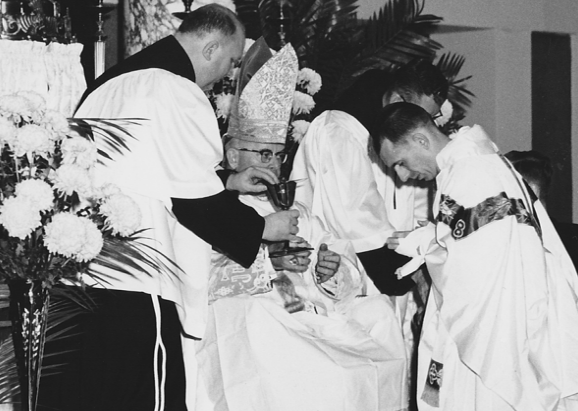
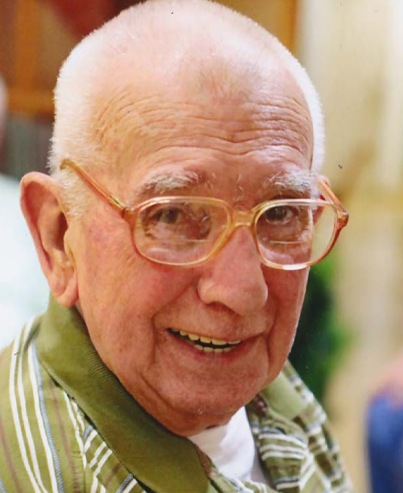
 Being a Capuchin priest is all Fr. Don Bosco Duquette ever wanted. He had to pay some dues along the way, taking assignments he would not have chosen for himself: publisher of Catholic tracts, director of novices, and even provincial minister. But through it all, he has served God, the Church, and the Capuchin Order gratefully.
We can be very critical of ourselves as a fraternity for our failures to follow as faithfully in the footsteps of Francis as we indeed should,” Father Don Bosco reflected. “However, when I look back over my years in the community, it’s the positives that certainly stand out: the goodness, the sense of community, the prayerfulness, the humility, and the hard work of the friars.”
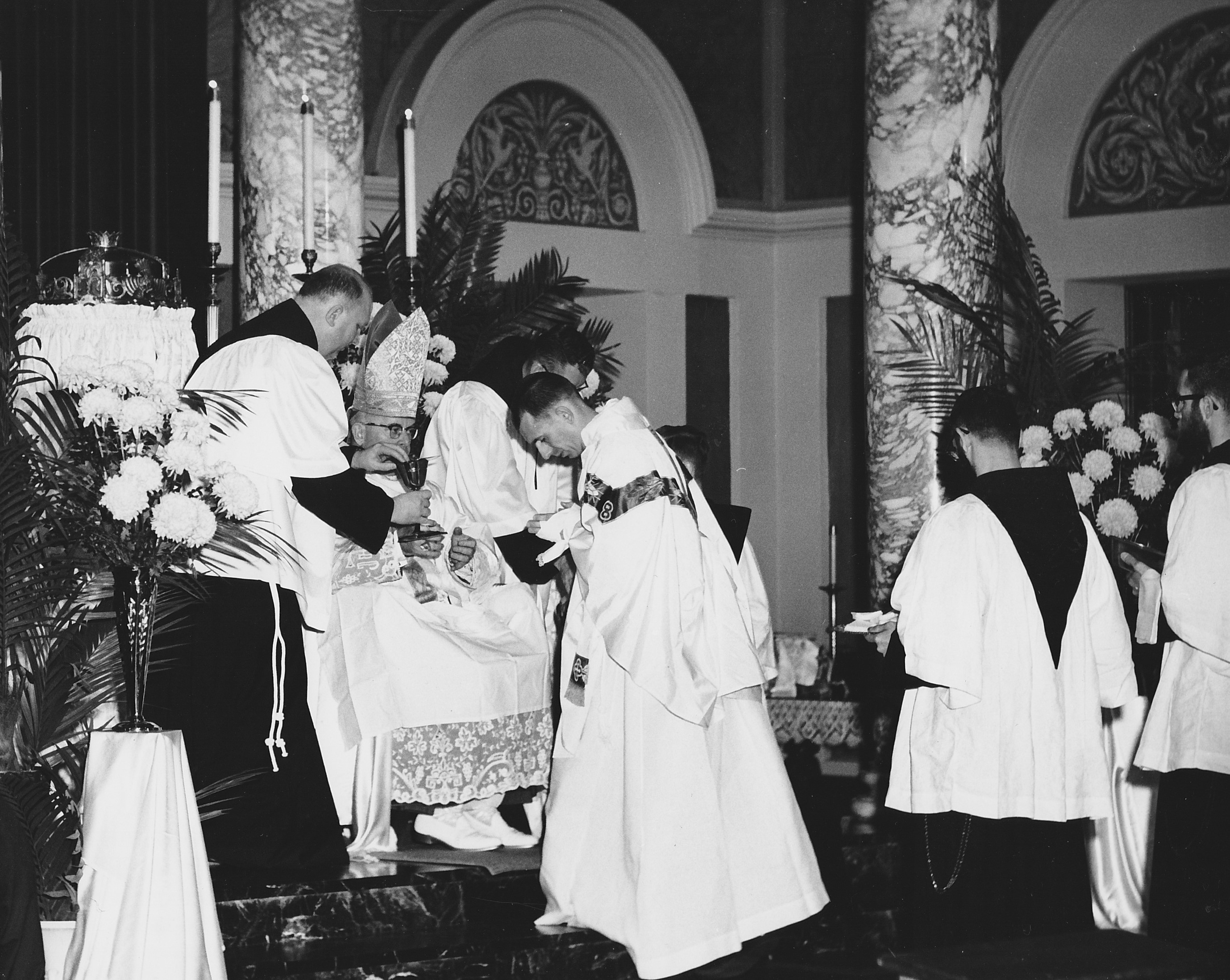
This year, Father Don Bosco is celebrating 65 years of religious life and 60 years in the priesthood. He feels just as much at home with the Capuchins today as he did the first time he met the friars.
A Door Opens
It was a spring evening in 1959 when John Duquette, then 26, arrived at the doorstep of St. Anthony Friary, the Capuchin house of theological studies in Hudson, N.H. He had learned about the friars from reading The Cowl, a publication of the Province. He accepted an invitation from the vocation director to visit the Hudson friary. So, after a usual day at the office of the Manchester Union-Leader, where he was working as a credit manager, John went to St. Anthony.
He rang the bell, and Br. Paul White (d. 1985) opened the door. “And I was taken with that man,” he recalls. “I never met a Capuchin before. But he was just so gracious, and he impressed me to no end. And that night I spent with the vocation director, and I met all the friars.” All fifty of them!
Despite having just met these men, he says, “I was very surprised at how comfortable I felt with those guys, and how they related to one another—very brotherly. And I thought to myself, ‘You know, this is what I’m looking for!’ And the next morning I filled out an application to join the Order, and I mailed it in. I made up my mind very quickly!”
It was an abrupt change of course for the future Father Don Bosco. It was a change foreshadowed several years earlier by an incident during his studies in business administration at College of the Holy Cross in Worcester, Mass. “In my senior year, I took an aptitude test. And [with the test] they tried to place people in jobs around the country. So a guy gave me the test. And afterwards he saw the results and said, ‘What are you doing? Business administration? You’re a people person!’ ”
This “people person” with an acumen for administration went on to apply both his relational skills and his business sense over a lifetime of service to the Province.
Ministries
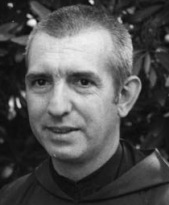 In 1966, two years after his ordination and following advanced studies in theology, Father Don Bosco went back into the media business. Only this time it was religious media, working at the Catholic Information Society, which published pamphlets of Catholic apologetics that were distributed to parishes across the United States. His task was to ensure that the pamphlets conformed to the theology of the Second Vatican Council. He assisted Fr. Bonaventure Fitzgerald (d. 1974) in this work, first at St. John the Baptist Friary in New York City and then at St. Pius X Friary in Middletown, Conn.
Then, in the summer of 1969, Father Don Bosco received a new and unexpected assignment directing the novitiate program at St. Lawrence Friary in Milton, Mass. “You can imagine: here I was, novice master, with no preparation whatsoever! And I was trying to train these novices. The first class I had was 33 guys!”
Experience became Father Don Bosco’s teacher, and he brought to the formation ministry his own experience as a novice at the Milton friary just 10 years before. He remembered how new and different Capuchin spirituality was in the beginning. For instance, although he had been a daily Mass-goer, he had never prayed the Liturgy of the Hours before. He also remembered how young and raw the novices were. In those years, most novices were only 18 years old, having just graduated from Glenclyffe, the Province’s high school seminary in Garrison, N.Y.
For seven years, Father Don Bosco handed on the Franciscan spirituality he himself had learned more through practice than through study. “When I was going through formation, we had no Franciscan theological content. We never studied Bonaventure or Duns Scotus. We didn’t have any theological training within the confines of Franciscan spirituality.” He praised the Province for developing studies in the Franciscan intellectual tradition in the years since.
In 1976, Father Don Bosco was elected the vicar provincial minister, and a new ministry in administration beckoned him. Five years later, the friars elected him provincial minister. He carried out his duties in governing the Province capably, although with a longing to move on to the field he felt most drawn to—pastoral care in parishes. When his term as provincial minister was nearing completion in 1984, he wrote a letter to the friars humbly asking them not to re-elect him.
The friars obliged, and Father Don Bosco got the opportunity he had long awaited. Over the next three decades, he served at Sacred Heart, Yonkers, N.Y.; St. Pius X, Middletown; and St. Joseph, Portland, Me. He was simply a priest—he turned down the offer to be made pastor multiple times—preaching, administering the sacraments, and being with the people. “I finally fell into the place where I felt I should belong! I didn’t want to be a superior. I was a people person, and now I was meeting and serving people, all the time. That’s where I felt comfortable.”
Live Simply, Love and Serve Others
What has Father Don Bosco learned about the Capuchin way of life after 65 years? “The key value is poverty, in my mind. You’re supposed to live as a poor person. Now that is a general challenge today. Everything is high-tech. I don’t think it’s our way of life. I have tried my best to lead a simple life.
Another lesson in Gospel life came from his family—be of service to others. All of his siblings entered the helping professions: two brothers became educators; one sister, a nurse; another sister, a social worker
Father Don Bosco credits his father, John, who left school after 7th grade to support his family, with instilling a service mentality. “There’s only two kinds of people in this world: those who need help, and those who don’t need help. I am interested in helping those who need help,” he recalled his father John saying. His father was a bookkeeper for Crane and Co., the paper mill noted for manufacturing the paper used to print U.S. currency. The Duquette family lived in Dalton, Mass., where Crane owned the home they rented for $18 a month. They lived simply but were treated well by the company. The owner gave John $300 a year for his eldest son’s studies at Holy Cross and even offered the young business student a job upon graduating.
The elder John extended that magnanimity to others. Father Don Bosco recalled his father, a local Republican party chair, having a close personal friendship with the Democratic party chair. One time, Father Don Bosco urged his father to impose some discipline on a wayward member of family. “He says, ‘Let me tell you something. If nobody loves you, you might as well be dead. And you know what? I’m the only person in the world who still loves that kid.’ Wow. I had no reply to that. So I went back to my mother and said, ‘I lost that one.’ ”