



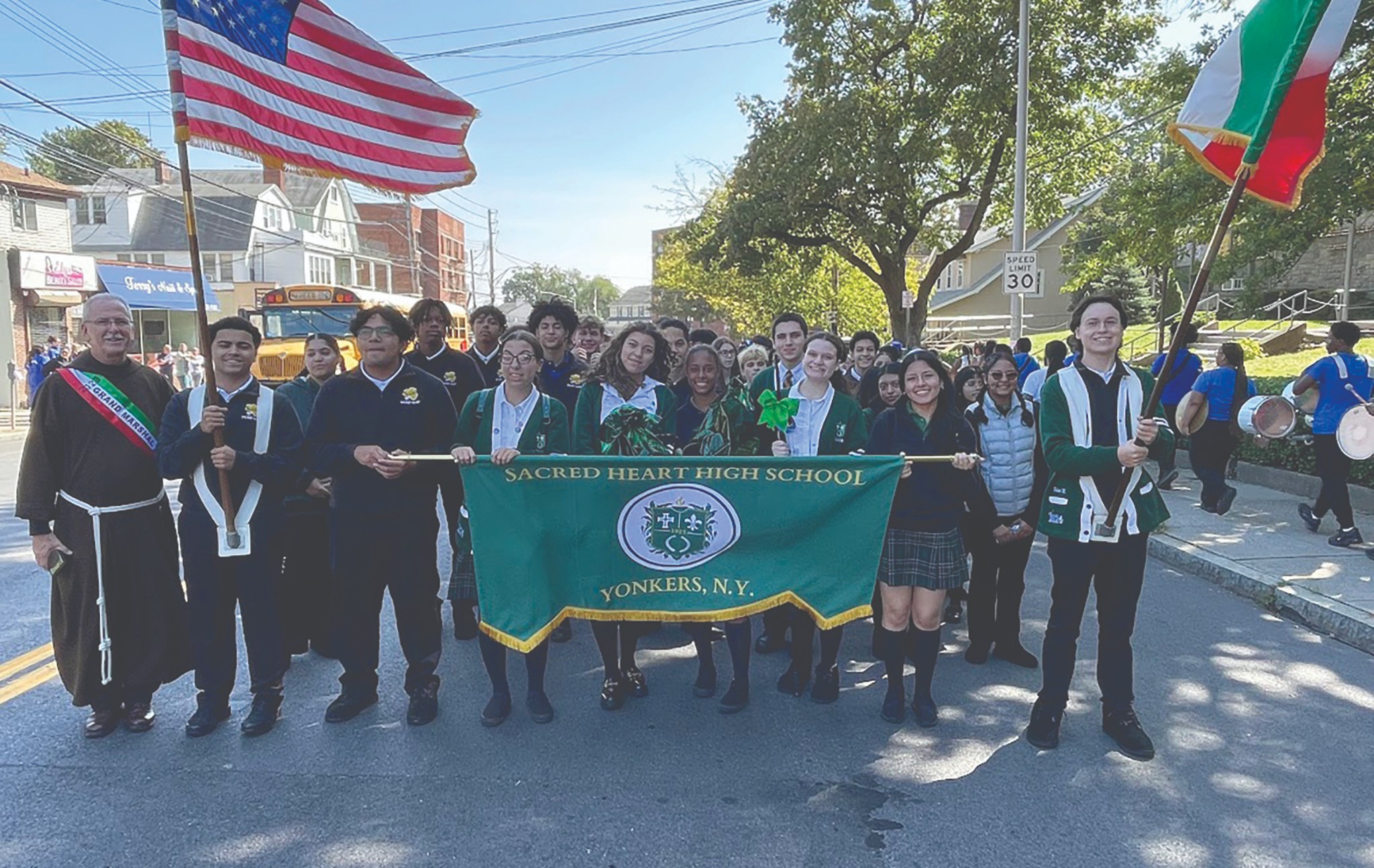
 For generations of faithful in the United States, their identity as Catholics was deeply entwined with the parish they belonged to and the parochial schools they attended.
This holds true for so many of the faithful who grew up in Yonkers. The heart of their Catholic identity comes from Sacred Heart Parish and in a special way from Sacred Heart High School. For 100 years, the high school has formed the faithful and evangelized them through education.
“There was an incredible spirit in the school because it was so neighborhood-oriented,” said Fr. Senan Taylor, who graduated from the high school in 1962 and went on to teach religion there from 1971 to 1978. “The school spirit was not just rah-rah-rah. People would ask you what school you went to, and you told them The Heart, and they knew what you were talking about.”
An American Story
The history of the high school tracks the history of American Catholicism in the 20th and 21st centuries. (See Timeline, Page 16, for more details.) The school was born at the close of an era of massive immigration from Europe. It first served the children of Irish-American families—the school once boasted a bagpipe band—and then many other ethnicities. It grew dramatically during the postwar boom. Its enrollment crested at 1,200 in the late 1960s, with faculty from three religious orders.
John McCormick, 56, grew up in Yonkers, and like his parents before him, he attended the high school. While he was a student there, so did nine of his relatives! “One really fond memory I have of Sacred Heart High School is seeing my cousins in the hallway every day,” he said.
McCormick graduated in 1985. Today, he lives in Pelham, N.Y., and has a career in asset management. He credits the high school with propelling generations of graduates like him upward into society. “It plays a really vital role in Yonkers,” he said. “It’s the only Catholic high school in Yonkers. In addition to developing moral and spiritual character, it is a gateway to the middle class and beyond for a lot of students who for one reason or another might not thrive in the public school system. It is an agent of positive change in students’ lives.
“I think in a post-industrial city like Yonkers, it would be hard to overstate the importance of the opportunities that Sacred Heart opens for students. I feel passionate about creating pathways for deserving students. It’s really important.”
For Judith Juback Griffin, 83, the school was a place of safety and stability during a turbulent childhood. “I love Sacred Heart High School. It was a safe haven for me as a child growing up in somewhat of an unhappy household. The greatest thing was the camaraderie with my friends and students I met there. The teachers gave me an opportunity to think. And without even knowing it, I was growing spiritually.”
After her graduation in 1958, Juback Griffin would endure several trials in life: a divorce, unemployment and near bankruptcy, and her brother’s death. But her Catholic faith, instilled by the friars at Sacred Heart, came back to her to sustain her. “The reality is that my Catholic faith has actually provided a lifestyle for me and carried me through the challenges of everyday living. My Catholic faith is the foundation of my life today. By believing in God, it has enabled me to deal with every trial and tribulation that has happened in life.”
“Now and then, troubled students would come and talk to me,” Father Senan recalled. “There are people I had in high school who still call me. I am not surprised, because we really bonded, and that continues. So I feel like an uncle or a godparent. They are not calling me because I am a priest. They are calling because of the kinds of relationships you could develop at Sacred Heart.”
Challenges
The seismic waves of the Second Vatican Council and the social and cultural revolutions of the era shook the Church and its institutions. Sacred Heart High School felt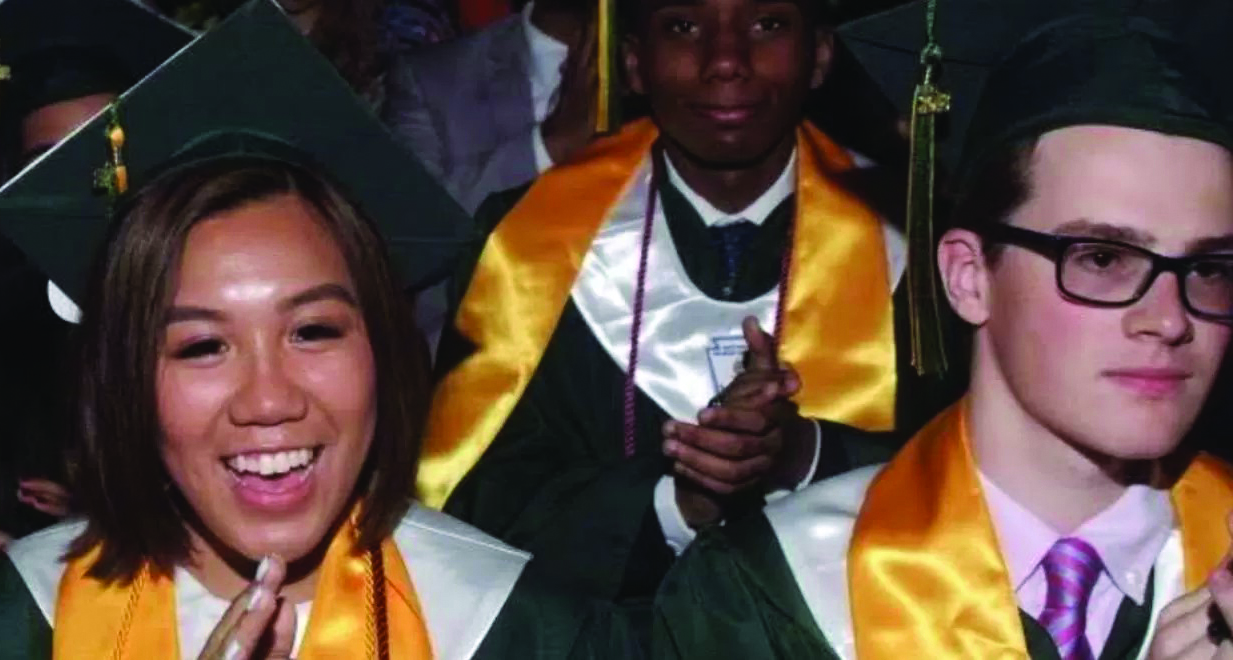 these reverberations, too.
“It was a very exciting time. It was right after Vatican II. It was around the time of Woodstock,” said Father Senan, who took a humanities-based approach to religion, applying what was happening in the world at the time of Jesus to the present day. He rented a movie theater so his students could see Godspell and organized a class trip to Broadway for a performance of Jesus Christ Superstar. “The cultural atmosphere was alive with religion. The way I taught religion, I tried to make it as interesting and palpable as possible.”
As time went by, priests and religious on faculty diminished in number, as did enrollment because of smaller families and rising tuition. But God always provides. Increasingly, laypeople became the teachers and administrators and carried on the legacy of the priests, brothers, and nuns who went before them. And new families arrived who wanted their children to have a quality Catholic education.
Fr. Bernard Maloney, who taught religion at the high school from 1970 to 1972, was pastor of Sacred Heart from 1993 to 1998. He recalls those latter days: “The enrollment was about 400 students. The school was struggling financially but making it. In the Archdiocese of New York, it was one of two parish high schools. Within my five-year period, the high school had three principals, and teachers left for higher salaries at public schools. I met weekly with school administrators to keep informed about the direction they were leading the school and the difficulties they were experiencing. Mine was a supportive and helping role.
“The ministries of teacher and pastor provided me the opportunity to encounter children, youth, and adults, and to love them by being the servant to them as best I could in striving to imitate Jesus. Despite the hardships of a teacher and pastor, those ministries are a joy that stays with me.”
Sisters and Brothers
For most of its history, the high school was staffed largely by the Sisters of St. Agnes. This congregation would have a long and fruitful collaboration with the Capuchins, dating back to 1870 in Fond du Lac, Wis., when Fr. Francis Haas, co-founder of our Province, became spiritual director to the sisters. The Agnesians began teaching at the Capuchins’ Our Lady Queen of Angels Parish in East Harlem, Manhattan, in 1886. They readily accepted the call to Yonkers several years later, when the parish grade school opened in 1893, and they would remain a vital presence in the education of Sacred Heart’s youth for a century.
For a generation, the De La Salle Christian Brothers also served the school, beginning in the 1960s as enrollment soared and, for a time, the young men and women were being taught in separate departments.
Many a Capuchin friar taught religion in the halls of the high school (see Honor Roll). It was a rite of passage for young friars. Father Senan recalls: “If you were newly ordained, you were assigned to teach at the school. It was part of the experience. It took a few years for me to get into it.”
It was a transforming experience for friars as well as for the students. “When I went to Sacred Heart, that is when I learned theology. When I went to Sacred Heart to teach, that is when I learned to preach,” said Father Senan. Handing on the Catholic faith was not about showing what he knew; rather, he said, “you are trying to get people to get the meaning of Gospel.”
Juback Griffin praised her Capuchin teachers as very knowledgeable and very soft spoken. “In hindsight, we were lucky to have their knowledge and information,” she said, while adding that she and her peers wondered why they had to learn Latin! She also recalled her class attending Mass at Sacred Heart Church during Advent and Lent. For women, the school’s dress code at Mass was white berets, blue skirts, white blouses, white saddle shoes, and white socks. Men wore suits and ties.
What did students learn about God and Catholicism? “I think it was really about lived faith,” said McCormick. “There was certainly an intellectual component, but in my mind the emphasis was on living your faith and how you respect yourself and treat other people. That was not only taught in class, but it was the ethos of the school. Our religion is not something that we do on Sunday, but it affects how we treat people in every interaction.”
Evolution
The high school made its first home in the basement of the church, then moved into the former minor seminary building on Convent Avenue (see Timeline). During the pastorate of Fr. Finian Sullivan (1949-55, 1961-70), the modern facilities, first its wings and then the circular main building and administrative building, were erected.
The school is about to undertake a campaign to upgrade the facilities, particularly its science lab
rooms. Other major improvements have already been made. The school replaced a boiler recently. The ceiling fans were replaced during the Covid-19 pandemic. The entire building has also been rewired for wireless internet, making it possible for the school to use a donation for the purchase of Chromebooks.
When Juback Griffin was a student, tuition was $15 a month, and with after-school and summer jobs she could pay for her studies all by herself. “The student body came up from the streets back in the day,” she said. “We didn’t have an exam to enter the school system. Father Finian said to the freshmen, ‘You got in here because we needed bodies to fill the new wings of the school!’ ”
In contrast, tuition for the 2023-24 academic year is $9,850, not including other fees. It is an increasing challenge to keep the school affordable to the working class of Westchester. Accordingly, the school has a board of advisors drawn from alumni and academic, business, and community leaders to do strategic planning, fundraising, and fiscal oversight. This includes guiding the mission and vision of the school, finding new revenue sources, containing costs, and improving communications with alumni, students, families, and the parish.
“We are very proud of our momentum,” said McCormick, who chairs the board of advisors. “We are really focused on giving our students the very best opportunities coming out of high school.” For instance, the Class of 2023, a class of 63 students, had a 100 percent graduation rate, a 100 percent college acceptance rate, and was offered over $11 million in scholarships. The school has also kicked off a centennial campaign, establishing the Green & Gold Fund to support students by providing funds for curriculum enrichment, special projects, new programs, educational equipment, organizational development, and other needs.
Father Senan and other alums praised the spirit of Sacred Heart High School for binding together the Yonkers community, a spirit forged in its blue-collar neighborhoods, reinforced by the Capuchin friars and Agnesian sisters, and guided by the Holy Spirit. We leave the last word to current senior Adriana Williams, who spoke at the school’s centennial gala on Nov. 2. “Being a part of this school was the best part of my life,” she said. “I truly hope that everyone who comes to the school will feel the same way I do and never leave.”
  |
|
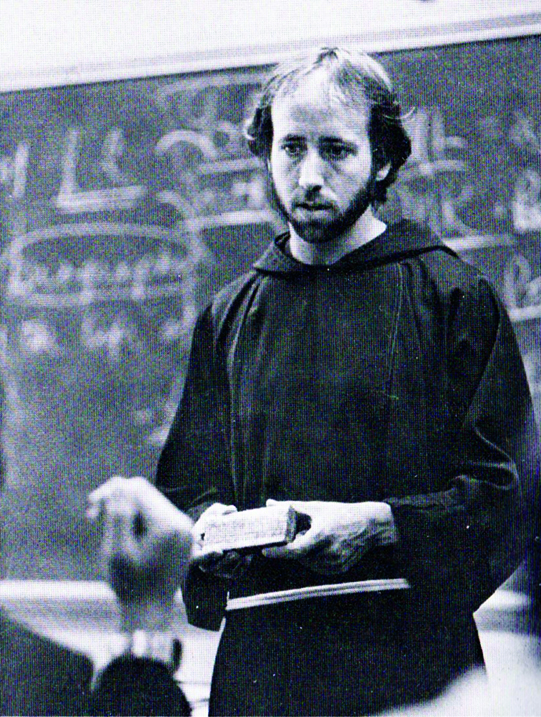
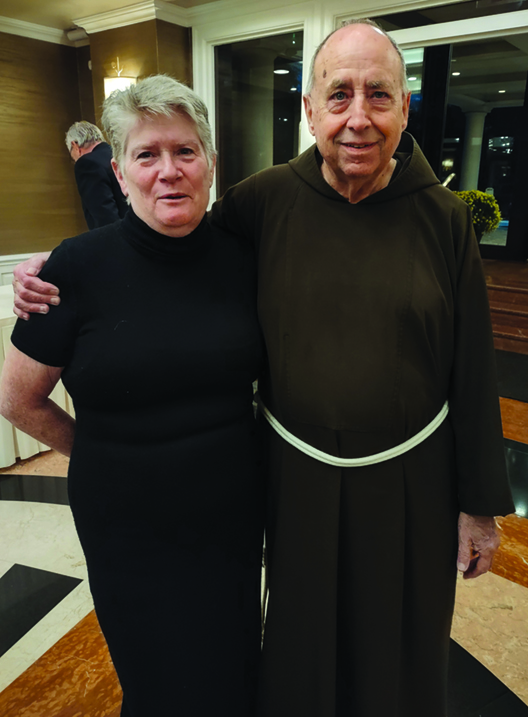
Fr. Senan Taylor in the religion classroom and with alumna Deanne May. |
| Sacred Heart High School Timeline |
|
1905 - 1906 A preparatory seminary is established at Sacred Heart Parish, Yonkers, with a 2-year course for boys studying for the priesthood. |
|
1915-16 Ground is broken on Convent Avenue for a seminary building in August; the school is dedicated in July 1916. |
|
1921-24 The Province purchases the Glenclyffe property in Garrison, N.Y., and moves the seminary there. The parish purchases the building on Convent Avenue for $50,000. It is converted into a high school. |
|
1923 Sacred Heart High School opens. Instruction is in two rooms in the church basement with 14 students and one teacher from the Sisters of St. Agnes. The school offers a 2-year curriculum of business courses. |
|
1924 The school moves into the Convent Avenue building. It is the first co-educational Catholic high school in Westchester County. |
|
1925-26 The high school applies for accreditation from the New York State Board of Regents. Curriculum converts to a 4-year academic program. Four rooms are added to the school building. |
|
1930 The Board of Regents grants full accreditation. |
|
1950-51 The facilities are upgraded with additional classrooms and administrative offices. Enrollment is at 420 students with capacity for 500. |
|
1954-55 Fr. Finian Sullivan begins renovation and expansion, adding two wings with 16 classrooms, a cafeteria, and a library. Enrollment capacity increases to 800 students. |
| 1961 The De La Salle Christian Brothers join the faculty. The school becomes a co-institutional operation, with the Capuchins and Christian Brothers teaching the boys and the Sisters of St. Agnes teaching the girls. Ground is broken on a new, main building for administration and instruction, including cafeteria, chapel, gym, laboratories, and library. |
|
1965-67 Expansion is completed under Fr. Finian Sullivan’s leadership. Christian Brothers take residence in main building. Enrollment exceeds 1,200 students, with a capacity for 1,600. |
|
1969 The school returns to a co-educational model. Enrollment reaches 1,260 with 64 faculty members. |
|
1979 The high school revises its academic program. |
|
1990 The Christian Brothers depart. Faculty members are mainly lay persons and sisters. Senior friars take residence in main building to form St. Clare Friary. |
|
2018 300 students enrolled with 98 percent graduating and going on to college. |
|
2023 Sacred Heart High School begins its second century of providing a quality Catholic education to the young women and men of Westchester and the Bronx. |