



Every several years the Capuchins hold special assemblies called plenary councils to address one or more themes relevant to the ongoing renewal of our Order. The Ninth Plenary Council of the Order has begun. It is taking place in Rome through Oct. 30. There are 30 delegates participating from around the world; they represent the nine conferences of the Capuchin Order. General Minister Br. Roberto Genuin and the general council are presiding over the plenary council. The purpose of this plenary council is to reflect on mission and collaboration.
Please pray for the friars who have assembled to help fan the flame of our charism. For news and updates, visit https://www.ofmcap.org/
See below for a video of the opening ceremony on Oct. 12.
The general minister invites all the friars of the Order to transcend local boundaries and open themselves to genuine fraternal solidarity.
The first week of the plenary council was devoted to the presentation of various reports designed to help delegates reflect on and discuss mission, collaboration, and the vision of the St. Lawrence of Brindisi fraternities. On the second day of proceedings, the delegates discussed changes in contemporary society and the need for a more prophetic Church, drawing inspiration from the beauty of evangelization and the encounter between cultures.
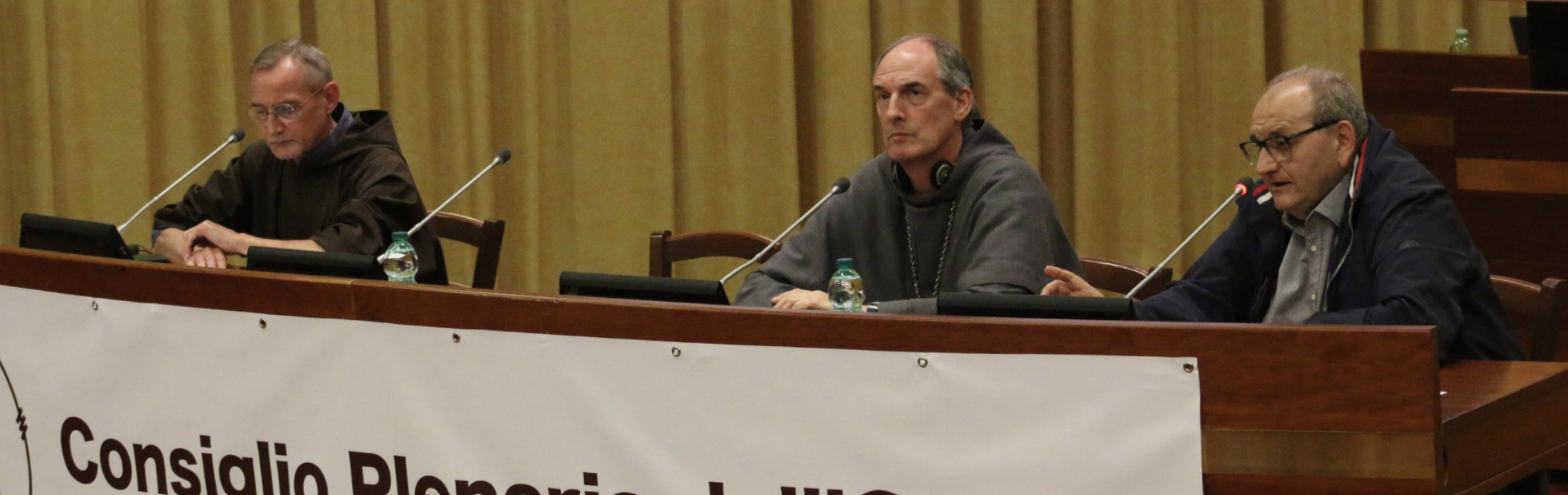
October 13
Cardinal François-Xavier Bustillo, a Conventual Franciscan and bishop of Ajaccio (Corsica, France), called for authenticity and missionary courage. He urged the Church to move beyond bureaucratic “management” and return to a prophetic “vision,” rediscovering a passion for the Gospel. Fr. Fabrizio Meroni of the Pontifical Institute for Foreign Missions said that the crisis of the Church’s mission is fundamentally a crisis of faith, love, and authentic Christian living. As Capuchin Franciscans, we are called to move beyond simply managing ministries and preserving structures, returning instead to the heart of our vocation: a deep relationship with Christ and a radical commitment to the Gospel. Inspired by St. Francis, we must embrace missionary audacity, creative fidelity to tradition, and the courage to follow the Holy Spirit into new and unfamiliar places. The Church must also rediscover the missionary responsibility of all the baptized, recognizing the diverse vocations through which Christians make Christ present in the world. The sacraments, especially the Eucharist, must remain at the center of the Church’s life and mission. Ultimately, renewal begins not with more programs or activities, but with a genuine encounter with Christ that transforms our lives and enables us to share God’s love, hope, and joy with others.
October 14
The day featured presentations on interculturalism and the Order’s missionary history. These themes encourage us to understand how to navigate a world undergoing profound and rapid changes.
Bishop Paolo Martinelli, a Capuchin who is Apostolic Vicar of Southern Arabia, spoke in the morning about his experience in the Persian Gulf states (United Arab Emirates, Oman, Yemen). In this region, 34 Capuchin friars serve approximately 3 million Catholics from over 100 nations.
In the afternoon, delegates listened to friars who work directly in the mission fields. Br. Paolo Maria Braghini recounted his 20 years of experience in Belém do Solimões in the Amazon. Br. Isidorus Yoseph Jawa, an Indonesian missionary sent to East Timor in 2010, testified that in a context marked by historical wounds and occupations, a simple fraternal presence is in itself a powerful Gospel message.
For Capuchin Franciscans, mission is the practical expression of their charism, which is rooted in Christ and embodied through their Franciscan identity and fraternity. Throughout history, Capuchin missionaries have adapted to different circumstances, cultures, and challenges. St. Joseph of Leonessa continued to serve others after his initial missionary efforts failed. Brs. Francisco José de Jaca and Epifanio de Moirans, who opposed slavery, demonstrated perseverance, charity, and a commitment to human dignity. The Order gradually developed missionary institutions, specialized formation, language learning, and international collaboration to prepare friars for effective service. Despite political upheavals, religious suppressions, persecution, and war, the Capuchins continued their mission, recognizing that missionary enthusiasm must be accompanied by intellectual, spiritual, and practical preparation.
Perhaps the most memorable moment of the entire discussion came when one of the friars asked a presenter what should be done in regions like northern India, where some friars are afraid to go because of the dangers involved and the possibility of losing their lives. The presenter responded, “Well, traditionally, Capuchin missionaries have never been afraid to die.” After that response, no one asked any further questions.

October 15
Bishop Rino Fisichella, pro-prefect for New Evangelization at the Dicastery for Evangelization, and Cardinal Luis Antonio Gokim Tagle of the Philippines, dean of the College of Cardinals (above), addressed the plenary council in the morning. They spoke about the Church’s mission and the challenges of today’s world, including individualism, digital distractions, the weakening of human relationships, competing understandings of freedom, and cultural divisions within society and the Church. The importance of cultural intelligence was emphasized, particularly the need to recognize personal biases, understand other cultures, and overcome ethnic, tribal, and caste divisions. The Church is called to model synodality by learning to walk together in humility, respecting human freedom, and fostering communion rather than division.
Several paths for evangelization were highlighted: spirituality and contemplation, the living Word of God, responsibility for others, beauty, and love. Particular emphasis was placed on the Franciscan commitment to the poor, the sick, the dying, the marginalized, and those whom society considers unimportant. Forgiveness, reconciliation, and care for the vulnerable remain essential expressions of the Gospel and of the Franciscan charism.
Finally, the speakers emphasized that some of the challenges facing the Church today are also opportunities for renewal rather than reasons for discouragement. For Capuchin Franciscans, this requires a renewed commitment to fraternity, missionary zeal, and holiness of life. Authentic evangelization depends not simply on what is preached, but on how Christ is made present through a life of prayer, humility, love, service, and reconciliation.
In the afternoon, Br. William Hugo of the St. Joseph Province stated that collaboration cannot be reduced to a mere expedient for “filling the gaps” in ministries that have arisen in the West as vocations decline. He said the Order urgently needs a global strategic plan grounded more in fraternal relationships than in legal contracts. Br. Benny Vincent of the Sacred Heart Province, Quebec, warned against the risk of adopting a purely transactional model, which he described as the “rent-a-friar” approach. He stated that the Capuchin missionary is sent to enrich, through his presence and witness, a vibrant and well-structured fraternity—not to be regarded as a mere laborer intended to resolve local pastoral emergencies.
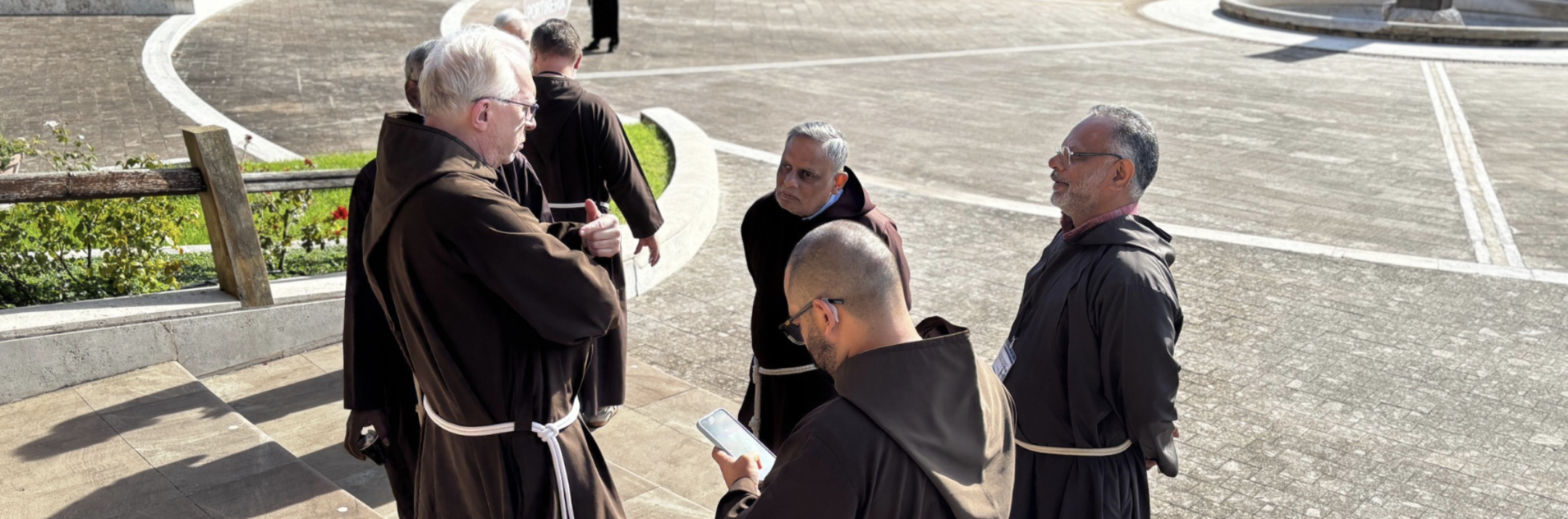
October 16
Br. Joseph Seraphin Dederick, provincial minister of the Our Lady of Angels Province in the western United States, and Br. George Antony Assaricheril, provincial minister of the St. Joseph Province of Kerala, India, gave testimonies on fraternal collaboration.
The experience of the Our Lady of Angels Province shows that international collaboration among Capuchin friars must go beyond addressing declining numbers and maintaining ministries; its true purpose is to renew the Capuchin charism and strengthen fraternity. Brothers from different countries enrich community life through their cultures, prayer traditions, and pastoral experiences, offering a visible witness to the Gospel.
However, successful collaboration requires careful discernment, adequate preparation, language and cultural formation, financial transparency, and clear agreements regarding responsibilities, the vow of poverty, and missionary assignments. Both sending and receiving provinces must share responsibility for the integration and well-being of the friars, recognizing that the goal is not assimilation but communion. Ultimately, international collaboration should be understood not as an exchange of personnel and resources, but as a mutual gift rooted in trust, humility, and a shared missionary vocation.
Br. Raffaele Ruffo, a French Capuchin, and Br. Marek Miszczynski, a general councilor of the Order from Krakow, Poland, spoke about the St. Lawrence of Brindisi Fraternities. The St. Lawrence of Brindisi project seeks to renew the Capuchin charism through international and intercultural fraternities centered on prayer, fraternity, simplicity, minority, and mission. Rather than simply filling personnel shortages, these communities aim to inspire the entire Order by demonstrating how authentic fraternal life can strengthen evangelization, formation, and collaboration between provinces. The St. Lawrence of Brindisi fraternity’s experience in the Amazon highlights both the challenges of intercultural living, including language barriers, individualism, and competing pastoral demands, and its potential to foster growth through shared prayer, dialogue, discernment, and responsibility. The brothers gradually learned that fraternity must come before activity, and pastoral ministry should be an expression of the whole community rather than an individual undertaking. Ultimately, the project emphasizes that authentic missionary collaboration requires ongoing conversion, mutual listening, humility, and a commitment to living the Gospel together, making fraternity itself a powerful witness to Christ.
October 17
 Saturday was a half-day of work, which allowed the brothers to rest and take some personal time. The delegates heard personal testimonies from Brs. Massimo Lorandini, an Italian friar, and Christophorus Goedereis, a German who is delegate for Belgium and the Netherlands.
The presentations and testimonies have provided a rich and intensive time of reflection on the mission of the Order, collaboration, and the St. Lawrence of Brindisi fraternities. The presentations brought together experiences and perspectives from different parts of the world, including Africa, North and South America, Asia, and Europe. This international exchange highlighted both the richness of our Capuchin charism and the challenges we face in responding to the needs of the Church today. The participation of Church representatives, religious, and lay contributors also enriched our discussions. One of the central themes emerging from the week is that mission cannot be understood only in terms of missio ad gentes but must also address places where the Church is already established yet faces growing challenges in transmitting and living the faith.
Reporting provided by Br. Jose Vera, Province of St. Joseph, and General Curia, Office of Communications.