By Matthew Janeczko, OFM Cap.
The French mathematician and Catholic philosopher Blaise Pascal wrote, “Whenever the Church suffers, every Christian suffers.” In all deference to the great philosopher, I believe he got it backwards.
Whenever any Christian suffers, the whole Church suffers.
From the very first days of my candidacy, I found myself perpetually fascinated by the Testament of Francis. “The Lord gave me brothers … and told me to live a Gospel life…” “When I was in sin the sight of lepers was too bitter for me. And the Lord himself led me among them, and I showed them a heart sensitive to their misery…”
These two elements of the Testament always give me pause, always seem to weigh heavy upon my conscience, and perpetually serve as the bar against which I measure my faithfulness to the example of Francis and his companions.
Perhaps what struck me most about eight weeks in El Salvador, Honduras, and Guatemala is the realization that real people exist in these places (stunning, I know). Yes, indeed, real people made of the same stuff of which I am made: flesh, bone, life, hope, love, faith, sin, and temptation. Yes, the Lord gave me brothers – Capuchin brothers, Central American brothers, human brothers – who populate the world, whether I am aware of them or not.
The young children in “The Yunque” (The Anvil) section of Ocotepeque who filtered their “tap” water through a sock are my little brothers and sisters. The small girl, completely deaf and mostly mute, who flitted through the parish church giving hugs to anyone who she could find, is my little sister. The old man who walked down the mountain each day transporting a load of chopped wood on a sickly mule, holding his machete in his lone remaining hand, is my brother. The Central American novices with whom I lived, ate, prayed, laughed, and, vainly, attempted to understand: also my brothers.
And yet, there are some people in Honduras who I would not as proudly proclaim my brothers. The men who drank watered down paint thinner each morning, stumbling drunk,while shouting at passersby, are my brothers. The corrupt police, the polarized politicians (Honduras has red and blue towns too), the rich who daily ignore the poor, the poor who become desperate and violent: these too are my brothers and sisters.
On an almost daily basis, I found myself attempting to identify myself – proudly – with the plight of the poor, moving to judgment of those who ignore, increase, or take profit from the blight that spreads across Central America. But it’s not that simple. When Francis claimed a sense of fraternity with all, he truly meant all: the poor, the rich, the lovable and the unlovable. I found it devastatingly easy to claim as brother and sister only those who I thought deserved the title.
Thus, the most painful lesson of my summer came to pass. The Gospel life of fraternity is only sensible – and thus more incomprehensible for many others – at its broadest point. “The Lord gave me brothers…” and he did not tell me what to do with them, or give me a choice as to who they might be. But, it was, is and will be the Lord God who gives them to me and that can (and should) make it significantly more difficult to not include people in my fraternity.
And now as I sit here in my childhood kitchen while visiting my parents, I am reminded of the Dickinson line, “After great pain, a formal feeling comes…” This is the precise difference between what happened to me in Honduras and what happens to native Hondurans and to the Capuchins who serve there, for they do not, by and large, receive an “after.” I left Central America after eight weeks. Yes, I did my best to show a heart sensitive to misery to those I met during my summer, but my heart – biologically, at least – took a flight back to New York.
Perhaps then, this is the enduring message of my summer; or, more accurately, it is an extension of what I find to be the most exciting and painful privilege of being a Capuchin: a life on the move. At the end of my assignment, I left Honduras. Most people do not. And yet, if just for an instant – or even, please God, a lifetime – I can remember that each time a Christian suffers, the Church – and I – suffer too, I will be just a bit closer to dwelling amongst my brothers and sisters, the lepers.
During the Annual Capuchin Dinner 2011, 11 Capuchin Franciscans celebrating jubilees were honored during the Ocober 6 event celebrated at the Affinia Hotel in New York City. Together, these 11 friars marked 535 years of religious life and priesthood this year. Watch the video to learn more about these friars and their dedication.
The formation team: Bros. Jerry Johnson, Frank Grinko, Gerard O'Dempsey, and Bob Barbato. One of the many private rooms for novices. The novitiate’s refectory.
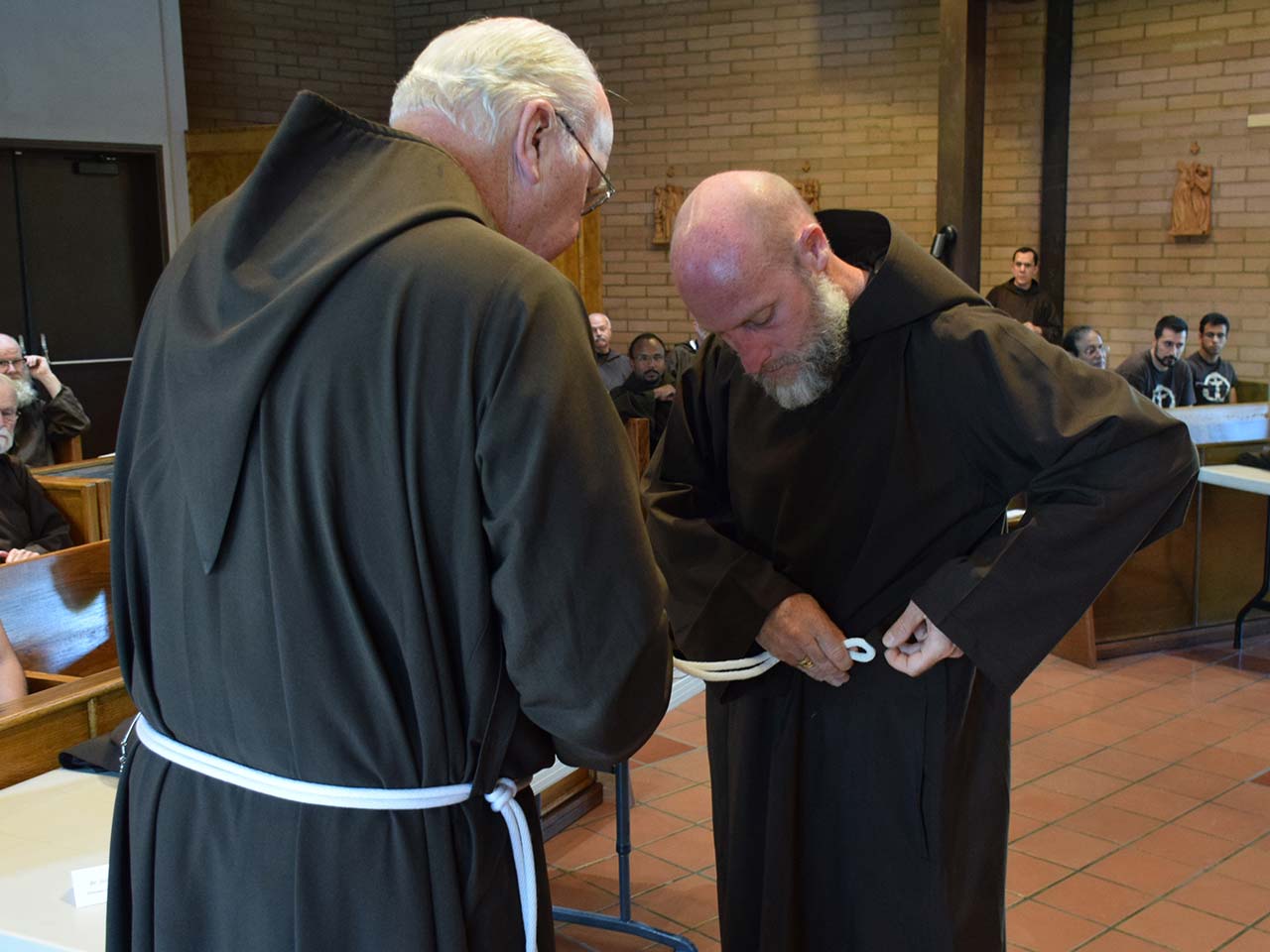
The novitiate is a one-year intensive spiritual program in which young men study sacred scripture, Franciscan writings, and the vows. Upon arrival they receive a habit, cord, rosary, and sandals. During this year, a novice decides if he is ready to continue his discernment process as a Capuchin Franciscan friar.
“It’s an intense year in which they decide whether they hear God’s call and are committed to making their first vows,” said Father Robert Barbato, Vicar of the San Lorenzo Novitiate. “Santa Ynez has a contemplative setting and the grounds are beautiful and spacious. To guide them during that year, there are four of us who are formators.”
In addition to its setting, San Lorenzo offers formation candidates excellent opportunities to do outreach ministry with the poor and the sick in the area.
“We have a good relationship with the community,” Father Robert said. “Most of our ministry work is done with Catholic Charities and is done at homeless shelters, parishes, and local hospitals.”
The new class of Novices arrived in San Lorenzo on July 24, 2011 and will be there until early summer 2012. As a novitiate, San Lorenzo will continue to its rich heritage of being a place of contemplative prayer, learning the Word of God, and community outreach for those in need.
The Province of St. Mary, New York/New England has recently accepted four candidates for Postulancy beginning August, 2011 at Saint Michael Friary in Brooklyn, NY. With gratitude to God, we offer our most heartfelt congratulations to John, Linneker, Will and Anthony.


Amid Mexico viole
nce, LI-born priest thrives
This article appeared in Newsday.com December 13, 2010
Originally published: December 12, 2010 6:40 AM
By BART JONES bart.jones@newsday.com
The 17 masked men pulled two teenage boys off the Rev. David Beaumont's truck in northern Mexico, forced them to the ground, and put guns against their heads as their mother screamed to the priest that her sons were about to be killed.
Beaumont, who was born in Hempstead and grew up in Commack, has spent the last 20 years as a Franciscan missionary in one of the most dangerous and violent areas of the world. On this day last April, he had to make a split-second decision.
"I was saying to myself, 'Well, now either I'm really going to be a missionary and be prepared to give my life for the people, or run and hide,' " Beaumont recalled in a telephone interview. "I felt it was a pivotal moment in my life. When I walked out to them [the masked men], I realized that the last thing I might see would be the bullets coming at me."
The men did not fire at the American priest in his tattered brown friar's habit, and he was able to get the boys back in the truck and leave with their mother. But for the next several days they were all so shaken they lost their appetites and could not eat.
Deeply spiritual mission
Beaumont, 50, who says his call to the priesthood started during his days as a boy in Commack, is a Capuchin Franciscan friar, a Roman Catholic religious order that takes its inspiration from the life of St. Francis of Assisi. Where he lives and works in northern Mexico is so dangerous the U.S. Embassy recommends Americans stay out of it. His home base village of Yécora lies in the state of Sonora, near the border with the state of Chihuahua.
Beaumont lives and works surrounded by guns, drugs and violence. Authorities say two drug cartels - the Sinaloa cartel and the Juarez cartel - control the surrounding areas.
Beaumont is an emissary to thousands of impoverished Indians in the Sierra Madre mountains in northwest Mexico, including some who, when they first saw the 6-foot-3 white man with long hair and a beard two decades ago, ran and hid from him in caves out of fear. Today, he is their hero and savior, a pied piper figure who speaks four indigenous languages and is swarmed by admirers when he walks the streets of the state capital, Hermosillo.
"I said to him, 'You are like the Jon Bon Jovi of Hermosillo,' " said his cousin, Long Beach resident Cynthia Younker, who is trying to make a documentary film about him. She visited her cousin last year.
People shout, and teenage girls pull out cellphones to take pictures with him, she said. At one point on her visit with her cousin, a police car with its lights flashing pulled Beaumont and Younker over as they drove through the city. The police officer wanted a picture, too.
Beaumont laughs off the adoration and says his mission is a deeply spiritual one inspired by St. Francis of Assisi, and the saint's devotion to Jesus Christ, the poor and nature.
"I feel very blessed to be able to live in the mountains . . . and to serve a beautiful and noble people who over the centuries have suffered a lot," he said.
His calling came early
Beaumont said he first felt the pull to the priesthood as a boy growing up in Commack. He adored the woods and streams near his home. Fire Island held a particular appeal.
"I loved to walk in the forest. I think that's where my vocation began," he said, adding, "I felt very strongly the presence of God walking along the beach."
When he made his first Holy Communion at Christ the King parish in Commack, a priest asked who in the group wanted to become a man of the cloth. Beaumont raised his hand.
When he was 8, his family moved to Los Angeles. By the time he was 14, he had read a biography of St. Francis and had been deeply moved. The next year he entered a minor seminary, and by 18 he had joined the Franciscans.
When he first arrived in rural Mexico 20 years ago, most roads were dirt, there was no electricity, and people traveled mainly by mule. Beaumont had to learn to survive on a diet of beans and tortillas.
Two decades later, he still travels by mule at times but also drives a frequently broken-down cattle truck that the Indians pile into for long rides, sometimes over snowy mountain roads. He's organized a multitude of activities from soccer for Indian boys who had never played Mexico's national sport to karate and kung fu classes for Indian girls.
He's never felt targeted by the drug cartels, though he's had to escape from armed highway bandits who block the winding mountain roads with rocks. He says the violence in the area is devastating.
"My greatest fear is the little children, growing up and seeing the results of the violence," including bodies left on the streets for hours before authorities remove them, he said.
After the incident in April, which occurred amid shootings and killings in several nearby villages, some of the Indians were so scared they stayed in caves for days without lighting fires for fear of the masked men finding them, Beaumont said.
Soon after the incident, he and others organized a religious procession that attracted 1,000 people. The event was "transformative," he said. "The joy came back to them after that day. They felt we can stay; we can live in our villages again in peace."
Despite the violence, Beaumont says he hopes to stay in Mexico the rest of his life.
"I feel like I belong where God wants me to be," he said.
Photo credit: The Washington Post/NIKKI KAHN | Father David Beaumont, a Franciscan friar lets the Pima children braid his hair during a visit to their village in the Sierra Madre mountains of Mexico. (Oct. 23, 2010)


Will Tarraza inqured of us in November 2009 and will be entering his senior year as a Theology major at Catholic University this fall. Will spent the past five months in Salmanca, Spain and shared his experience with us. His story follows...
God blessed me with the opportunity to live in Salamanca, Spain during a study abroad program with the American Institute for Foreign Study. I could write a novel about the time spent in Salamanca, however, I will keep this fairly short. The article brought to light two major changes in my life: first, I had to change the default language on Microsoft Word back to English from Spanish, and second, I referred to myself as a senior in college.
Writing in Spanish was a challenge for me. I cannot say that I have returned to the United States with perfect grammar and a vast variety of Spanish vocabulary; though, I can say there has been an immense improvement in my ability to use the language correctly. I have discovered, as many of my peers discovered, that although the University of Salamanca was fruitful in terms of education in a classroom, the city and culture of Salamanca provided as much knowledge. My time abroad may be characterized by the freedom from the daily routines I possessed in the United States and the obliteration of any expectations I might have had before embarking on my journey. The comforts of having typical Spanish meals prepared twice a day by my host “Madre” and the joy of daily Mass at one of the many historical churches made the transition to the foreign lifestyle much easier than I expected.
As mentioned, expectations could not exist if I desired to experience the real Spanish culture. Everyday seemed to provide a new lesson, a new cultural difference, a new face, but most importantly: a new challenge. I traveled with a non-religious affiliated program, which meant I would have to venture outside the comforts of being “Catholic at Catholic.” I have been in Catholic school since high school. Consequently, it would be a new experience to show my Catholic identity among the group who may or may not have been religiously affiliated, and also among the Spanish culture. I believe it was a blessing to be able to share with my friends about our faith.
I grew very close with my family abroad: a single woman in her fifties standing about 4 feet, 9 inches and two other Americans from the same program as myself, one from Chicago and the other from Western New York. We had an interesting way of life, for each week, my Madre would host different students from around Europe, mostly under the age of 18, as her means of income. This was a wonderful opportunity to meet students who merely wanted a taste of Spanish culture and would travel at times 20 hours or more on a bus to take a week of classes in Salamanca. Our family bonded over evening discussions of current events around Europe at the dinner table or interactions with the foreign students. My host mother became my “mother away from home.” She provided more than the expectations of our program and allowed my roommates and me to get a true understanding of the lifestyle of a single-woman in Spain.
European education is extremely different from education in the United States. Basically one’s grade depends on a midterm and a final exam and perhaps one or two short essays. The exams were typically based on class lectures; therefore there was not much work to do outside the classroom. Fortunately, Salamanca is a city with a deep, rich history that allows endless explorations to see the whole city. It was also very typical to get a coffee with friends or sit and read a book in the Plaza Mayor (main plaza of the city) and “people watch.” With all the extra free time, it’s very easy to get lost in the expectations one may have had in the United States. The free time allowed me to reflect on my life and my possible vocation. The free time allowed me to become independent from a schedule and listen to lives and experiences of not only Salmantinos, but also fellow Americans. I was able to become more patient, quiet, and relaxed without the extreme opposite lifestyle in the United States. It seems that change can be for the good or for the worse.
My experience abroad aloud me to journey outside my comfort zone and push myself to learn a new language, to discover a deeper relationship with Christ, and open myself up to students from all over the world. As I keep my Microsoft Word in English and embark on my senior year, I hope to be reminded of the tranquil lifestyle in Spain. I hope to use the quiet, tranquil lifestyle as a means of discovering God’s plan in my life. I will continue my journey here in Europe for 5 more weeks as I have the blessing to spend the time with my sister in the north of Europe, obtaining as much experience as possible and seeing God in all people and all things. Thank you for reading this brief overview of my time in Spain. If there is one thing I would like to leave you with, it is this: Whatever you embark on in life or wherever God calls you to be, do so with a smile on your face, without expectations, and with tranquility in your heart, for you never know what you will find, who you will meet, or who you will impact on any given day. I found that everyday during this experience, I learned something new about life. I only hope that someone learned something from me as well. Amen.

Andrew Skonieczny inquired of us in April 2009 and is a first generation American with strong ties to his family in Poland. He traveled to Poland this past October and decided to share his experience with us. His story follows...
I was really looking forward to traveling to Poland. Most of my family lives there. Having dual citizenship with Poland is great. I can visit my family anytime I want. Other than spending a summer with my family I had a wonderful opportunity to make a few pilgrimages.
Within a few days in Poland we made our first pilgrimage. This was my second time in the national shrine of Czestochowa. This is something that I have been looking forward to for a long time. When I entered the church with the image of our mother of Czestochowa I couldn’t take my eyes off the golden vault door that the image is kept behind. Waiting for the moment when it is lifted and the image is revealed. Praying in this place is something you experience only here. I wanted to visit Czestochowa for no other reason than to ask our mother Mary to pray for me with me, for my discernment to the Capuchin Franciscans.
When the image was being revealed, the trumpets playing, praying the rosary in that holy place brought me to tears.
That day will always be in my heart. I was in the very front of the church. I received Holy Communion on the altar. This was a rare experience. Usually the area in front of the altar is not open to the public. Since that day I believe that Mary is guiding me in my discernment. Mary helps everyone that goes there in some way. They have a wall where people leave gifts to Mary, thanking her for the help she gave them. That wall has everything from rosaries to crutches from the people that were healed. Long story short, the pilgrimage to the shrine in Czestochowa was really moving and strengthened my discernment to the Capuchins.
Czestochowa was not the only pilgrimage I made in Poland. There were a number of Marian sanctuaries that I had an opportunity to visit, some such as Pasierbic, and the Fatima sanctuary in Zakopane. All of them were just as moving and strengthening as Czestochowa. I also had an opportunity to go on a week long retreat in Zakopane. This retreat was not just any retreat. When I arrived I found out that this retreat was organized by a religious order. They were not the Capuchin Franciscans. They were the Chrystusowcy. This retreat was for guys in discernment to them...a small problem for someone in discernment with the Capuchins. They were very excited to find out I was from the states.
Their mission is to work with Polish people in other countries. This was a time to seriously think. But I soon came to realize that the Capuchin Franciscans are the right choice. The convent where we were staying was filled with Franciscans. Paintings and figures of Franciscan saints and of St. Francis were everywhere. By chance we also visited the hermitage of Brother Albert, a Franciscan saint. This retreat with the Chrystusowcy strengthened my discernment to the Capuchins.
Back in my home town of Kroscienko my discernment was also affected. About half way through the summer a group of visiting Franciscans came by with a group of kids, some sort of retreat. I noticed after a mass. There was some new priest at our parish and after mass I saw him in a Franciscan habit. Then for a few weeks I saw him walking around town and in the church. I don’t know if it is just me but the signs are everywhere and I have Mary of Czestochowa to thank for that.
Poland is always fun for me. Half the town goes to church daily, something you don't see too often in the states. I have an opportunity to go to church everyday in Poland. It's more difficult here. All the churches only have morning masses and I wouldn't be able to make it when I have school. Poland in itself is strengthening. In my town of Kroscienko it feels different when people look at you funny when you don't go to church, where as here in the states people are more likely to look at you funny if you do go to church, especially in school.
Other than my discernment and the wonderful religious experiences I had in Poland, I did lots of other stuff too. My stay in Poland would not be complete if I would not go hiking. I’m surrounded by mountains. I managed to climb a few peaks that I have been waiting to climb for a long time...one such is Giewont. I climbed Giewont when I was on my retreat. This is a great peak; it has a huge cross on the peak. I did a few local activities such as mushrooming, and farm work.
To top it all off my stay in Poland was great, to me Poland is another home, and I don’t consider myself a tourist there. Whenever I visit Poland it always strengthens my faith. This time not only was my faith strengthened but so was my discernment.